
HOW DOES ONE DETERMINE EGG COUNT AND EGG QUALITY?
- Antral follicle count – determines the number of eggs available that month.
- Anti-mullerian hormone (AMH) – blood test that determines the quality of the egg that month.
- What is Antral Follicle Count (AFC)?
During the first five days of the menstrual cycle, a vaginal sonogram is done to visualize both ovaries and see how many follicles are present.
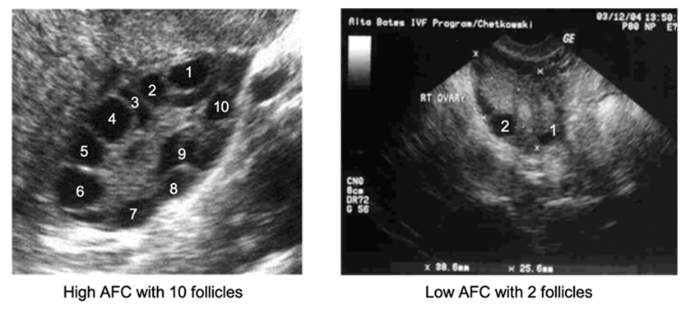
The follicle is a fluid-filled sac that contains an immature egg that is floating in the sac.
During the menstrual days, we can predict the number of eggs from each follicle of each ovary.
The AFC is very important because it tells us how many follicles our patient is producing that month, and the number of follicles we can expect to respond to stimulation whether we are given fertility drugs for IUI or IVF.
Patients with higher fertility potential are likely to have a higher AFC with at least 10 follicles.
What is Anti-Mullerian Hormone (AMH)?
AMH is a hormone produced by the gradulosa cells that make up the wall of the follicle which contains the immature egg.
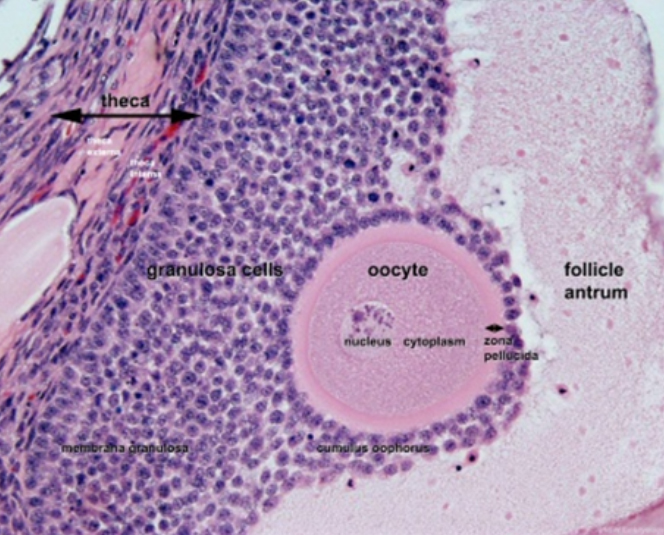
The Major Glycoprotein Hormones Involved in the Menstrual Cycle are:
a. Follicle-stimulating hormone
b. Luteinizing hormone
c. Thyroid-stimulating hormone
d. Human chorionic gona (hCG Pregnancy Hormone)
AMH in scientific terms is a “Transforming Growth Factor” that causes the growth and differentiation of egg cells in the ovary. It is produced by the “AMH-gene” which is located in chromosome 19 in all women. Therefore, AMS helps to regulate the recruitment or growth of follicles.
AMH plays a major role in recruiting follicles each month to be available and some of these follicles will continue to develop and eventually ovulate.
Without AMH, the follicles would be in a resting state and not move to the surface of the ovary. AMH will “wake up” these resting follicles and cause 20-30 to start to frow each month.
AMH provides the energy for the follicles to start to develop.
We measure AMH through help us determine the overall egg quality and number.
AMH is a strong indication about the size of the number of follicles present referred to as the ovarian reserve.
In patients with excellent egg quality, the AMH will be as high as five (5).
In patients with poor egg quality, the AMH can be as low as one or less than one.
In patients with PCOS, we have many immature follicles compared to patients without PCOS. And because of more follicles, the level of AMH can be as high as 20.