CAN FERTILITY TREATMENTS MAKE YOU MORE LIKELY TO GET PREGNANT EVEN AFTER 35?
Fertility treatment can be successful in increasing in odds of getting pregnant but fertility treatment cannot overcome completely the problem of decreased egg numbers and increased percentage of egg that are not genetically perfect.
Many studies have shown that the expected decrease in fertility potential, both in egg number and egg quality, can affect the outcome of different treatments that we offer our patients.
- Fertility medications such as Clomid, Letrozole, Gonal-F, Menopur – are greatly helpful to increase the number of egg cells that can be recruited to grow in a certain cycle. But fertility medication has a very limited effect on egg quality with a problem in perfect genetics.
- Intrauterine Insemination (IUI) is an excellent method to help couples achieve pregnancy. By concentrating the sperm sample into one to two drops and placing the drops carefully into the uterus, enters the fallopian tube to meet up with the egg cell. However, if the egg cell quality is inadequate, even with IUI, the chances for success are less.
- IVF – using fertility medication, multiple eggs can be stimulated and retrieved from the ovary and place into a petri dish. With IVF, we can inject a sperm cell into the egg and create an embryo that is later transferred to the uterus.
Theoretically, this should be a guaranteed pregnancy because the embryo is in the uterus and all it has to do is implant and it continues to grow. If unfortunately, the egg quality is poor, there will be less chance of having a healthy embryo so the IVF success rate will be less than expected for women of her age group.
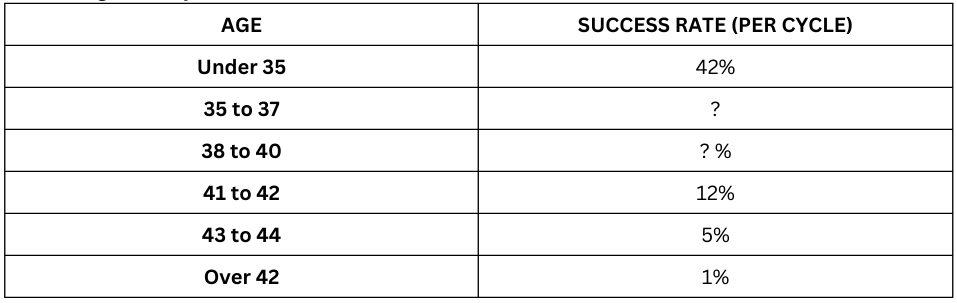
Success Rate with IVF for Women of Different Age Groups